Let me introduce you to the concept of
“Layers of Governance”
A layer is not a nation or a ministry. It is a sphere of responsibility defined by what it governs. Zones of responsibility: Water above and below ground, soil, energy, data, or health. Each domain exists because the issue it manages crosses boundaries that no single community or country can or should handle alone.
The layers of governance build upon one another:
Local Direct Democracy, where decisions are made by those directly affected
Domain-Based Assemblies, where issues of shared concern are coordinated across regions
Global Coordination Structures, where only planetary or interplanetary matters are addressed.
In the visual model below, each level corresponds to a different degree of transparency and currency — from the fully transparent global layer, through the partially transparent domain layer, to the private local layer where autonomy is preserved. These currencies are not economic tools in the traditional sense but accountability systems that reflect visibility and scope of responsibility.
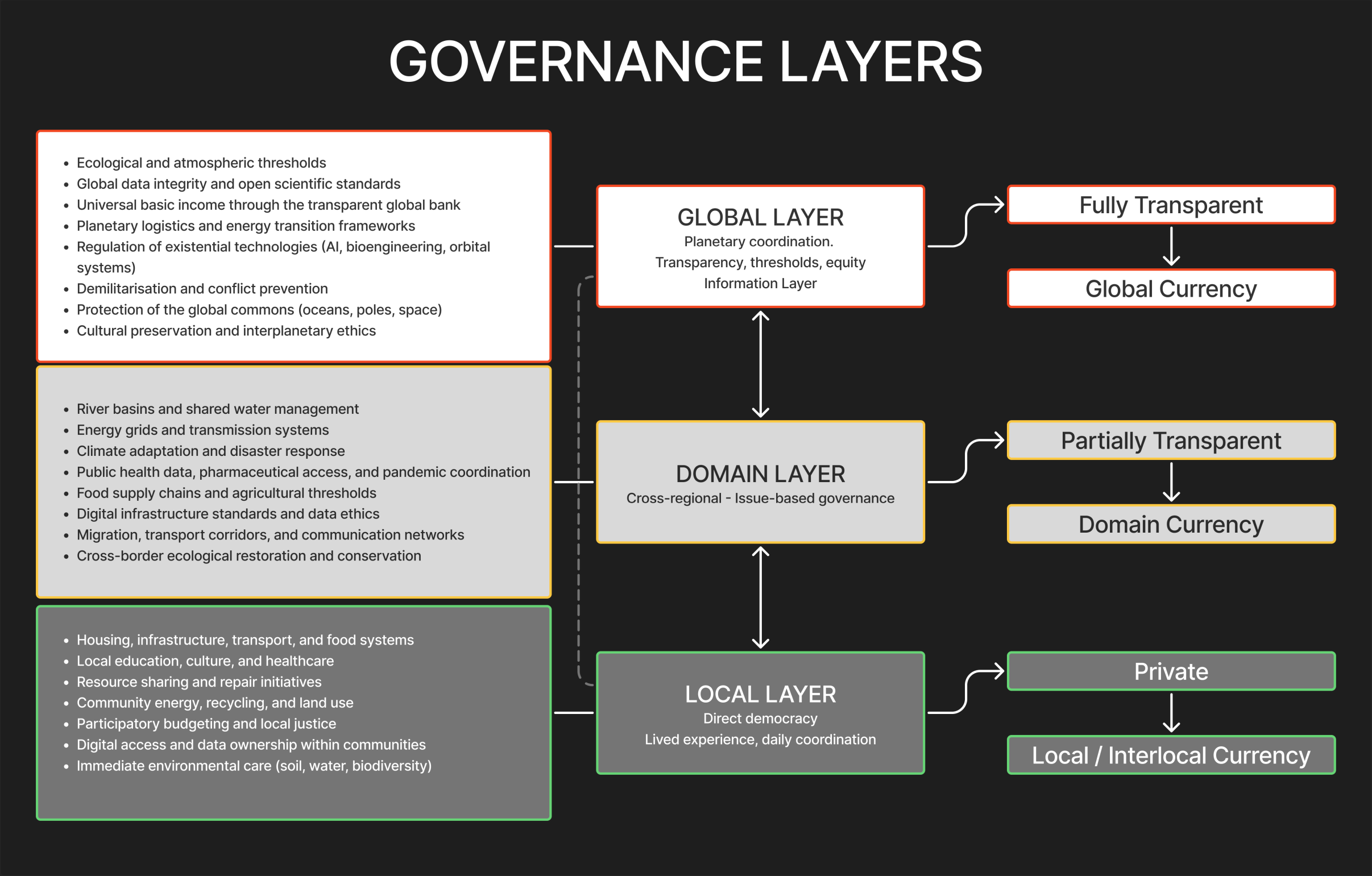
No layer functions alone. The layers of governance are interdependent and permeable. Each layer's primary focus defines it, but none is sovereign over the others. A topic rooted in one layer can be co-governed by another when its effects cross boundaries. Local actions inform domain coordination; domains translate shared knowledge to the global scale; global frameworks feed resources and insight back to the regional. All information is stored and publicly accessible globally unless private.
I. Governance is not the issue | rule is
I do not believe in a world without governance. I do not seek anarchy in the absence of structure or the elimination of collective responsibility. I think we need governance now more than ever, especially in an age of ecological collapse, where biodiversity, chemical balance, and cultural ecosystems face threats, technological acceleration, and geopolitical fragility.
In its truest form, governance is about coordination, not coercion: responsibility, not hierarchy.
The issue isn't whether we need a central government—it's what kind and on what terms. I believe in the possibility of a centralised coordination structure for Earth. Something global, intelligent, and humble. But it cannot rule. It must never rule. It must serve, and only in areas that require transnational coordination: ecological thresholds, digital infrastructure, scientific consensus, and ethical arbitration.
All other power must remain rooted in local, direct democracy, upheld by experience, and informed by empathy. Only from this foundation can higher levels of governance be justified—and only if they are always transparent, self-correcting, and permanently accountable to the layers beneath them.
II. Expertise Without Elitism | Empathy Without Sentimentality

The individuals responsible for guiding decision-making within this framework are not “politicians.” They are not media-trained figureheads. They are experts with domain knowledge, acquired through extensive work or deep lived experience. They are directly impacted by the consequences of their decisions, not shielded from them. They are not elected based on popularity but appointed through trust and proven understanding, within structured, reviewable systems.
This is not technocracy because it does not remove the human from the equation. It is not cold. It does not worship metrics. In this vision, decision-makers are not “experts” in the narrow sense. They are interdisciplinary stewards who act with an awareness that their domain is never isolated. No ecological decision is purely ecological. No economic framework is morally neutral. No health policy exists outside of culture.
The requirement is twofold: understanding and empathy. One without the other is insufficient. Knowledge alone can lead to tyranny, and empathy alone can result in chaos.
III. The End of Militarised Legitimacy
I believe it is possible to imagine a world without militarised power—without the constant background threat of organised violence. This is not because I think humans are peaceful by nature but because I believe peace can be created when we design governance systems that do not rely on enforcement through fear. In this framework, there is no need for a military as an extension of the state’s will. There is no war machine, because there is no ruling authority to defend.
The idea of “defence” is replaced with resilience. Ecological, informational, and infrastructural. Global coordination's primary work is ensuring these resilience forms are equitably distributed, constantly evaluated, and protected from systemic failure.
IV. A New Kind of Structure
This book will not attempt to provide a one-size blueprint. That would go against the very spirit of the idea. Instead, what follows is an exploration of the principles, mechanisms, and safeguards that could guide the formation of such a structure. It is not a manifesto. It is a scaffold for conversation, a framework for rethinking, and a challenge to the assumptions baked into modern governance.
It is also a personal reflection drawn from a persistent belief that we can organise ourselves intelligently, ethically, and with foresight—if we abandon the myths of necessary domination.
We begin, not with laws or parties or markets, but with a question:
What if power were not something held, but something distributed?
What if authority were not something imposed, but something earned?
What if governance were not about ruling but listening, evaluating, and serving? Always in that order?